


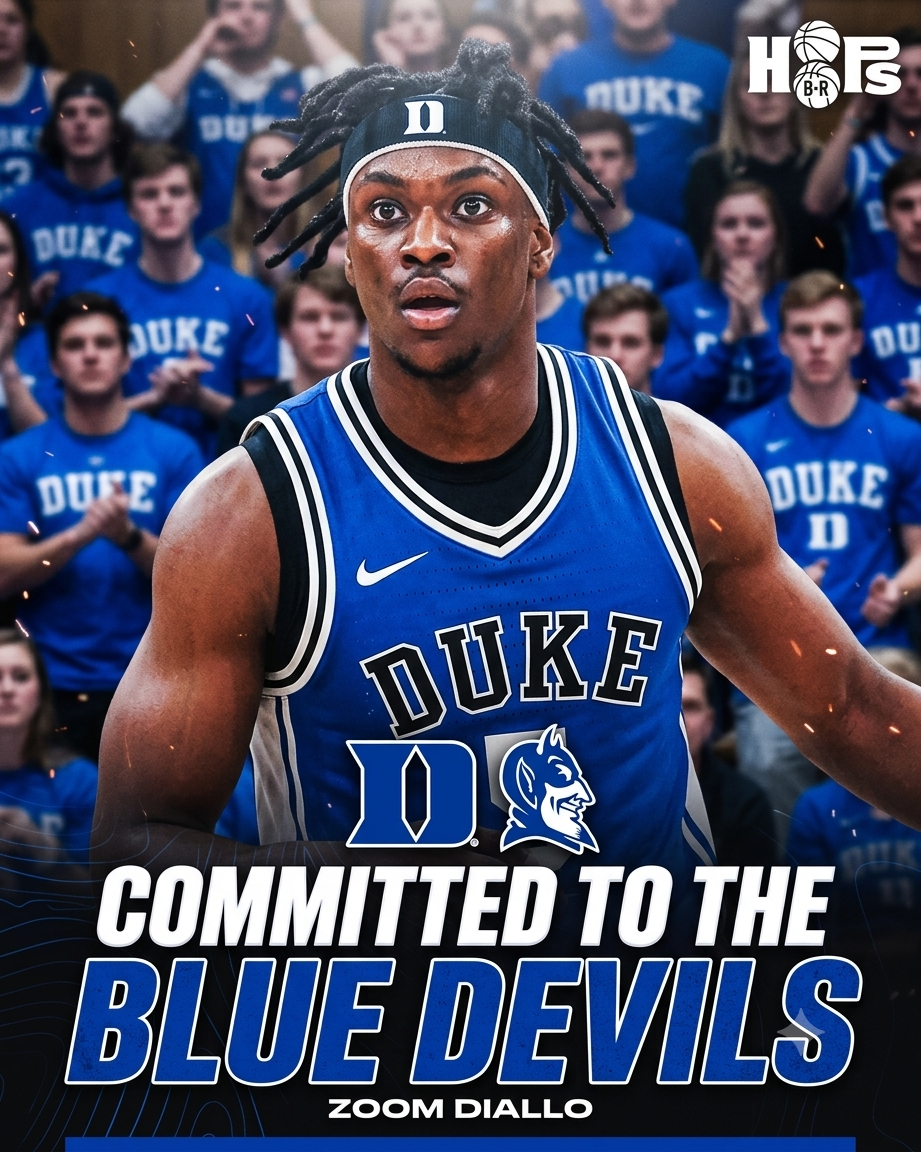
DUKE COMMIT: Nation’s 5-Star Recruit Flips Commitment To Duke Basketball Due To… Wait, No One Did
The Blue Devils have not experienced a high-profile de-commitment in the 2026 cycle. In fact, Jon Scheyer has secured the nation’s top-ranked recruiting class. Instead of flipping out, Duke is flipping the script on how to build a championship roster, and the strategy is already working.
DURHAM, N.C. – In the high-stakes world of modern college basketball recruiting, drama is the only constant. Commitments are made, celebrated, and all too often, broken as players chase greener pastures or programs pivot to the next big thing.
For Duke Basketball, however, the 2026 recruiting cycle is a story not of a star who got away, but of a masterclass in strategic roster construction. While other fanbases nervously track the transfer portal and recruiting rankings, Duke head coach Jon Scheyer has quietly assembled the No. 1 recruiting class in the nation for the third consecutive year, doing so by prioritizing a blend of elite youth and crucial veteran experience .
But the narrative is more nuanced than just bringing in top talent. It’s about what Duke didn’t do—and how the incoming freshmen are being asked to fit into a program built to win now.
—
The “Miss” That Was a Blessing
For several months, the recruiting world was convinced that 5-star guard Jordan Smith Jr., the No. 3 overall player in the 2026 class, was destined for Duke. The Virginia native had visited for Countdown to Craziness alongside other commits and received crystal ball predictions to land with the Blue Devils . However, in a late twist, Arkansas swooped in and secured Smith’s commitment, leaving Duke without the elite combo guard they had heavily pursued .
For many programs, losing a player of Smith’s caliber would be a devastating blow to the class and a black eye on the recruiting trail. At Duke, it might have been a stroke of luck.
According to analysts, while a Smith commitment would have added another 5-star name to the class, it would have created a logjam in the backcourt. Duke was already bringing in 5-star point guard Deron Rippey Jr. and returning experienced guards like Caleb Foster and Cayden Boozer . Signing Smith might have forced key veterans out via the transfer portal or prevented Duke from pursuing high-impact transfers like Wisconsin’s John Blackwell .
Instead, by “missing” on Smith, Scheyer gained the flexibility to build a more balanced roster. The Blue Devils will enter the 2026-27 season with one of the deepest backcourts in the nation, featuring Blackwell, Foster, Boozer, and Rippey—a unit perfectly balanced between experience and raw talent .
The Class: High-End Talent, Complementary Roles
So, who is actually coming to Duke? The 2026 class is headlined by a trio of 5-star prospects, each bringing a unique skill set to a roster that is expected to be one of the deepest in college basketball .
At the top of the list is Cameron Williams, a 6-foot-11 forward from Arizona. Rated as high as the No. 2 overall player and the top power forward in the class, Williams is an athletic specimen with immense long-term potential . He is an elite rim protector and rebounder with a burgeoning offensive game that allows him to create shots on the perimeter . Unlike some previous Duke freshmen who were expected to carry the load, Williams is projected to be the most likely rookie starter, but in a complementary role that will allow him to ease into the college game .
“I think I’m going to be the guy,” Williams told Rivals, setting a confident tone for his transition to college basketball .
Joining Williams are two other elite guards:
· Deron Rippey Jr. : The No. 1 point guard in the class and a McDonald’s All-American, Rippey is an elite athlete with a polished floor game. He can blow by defenders and finish at the rim, but his calling card is his tenacious on-ball defense .
· Bryson Howard : A 6-foot-4 wing who was a massive riser in the recruiting rankings. Howard might have the most complete scoring arsenal of any incoming freshman, capable of creating his own shot from all three levels and being a versatile defender .
Duke also secured a fourth 5-star caliber player in Joaquim Boumtje Boumtje, a 7-foot-1 center who played professionally for FC Barcelona. Because of his international status, he isn’t ranked in the 247Sports Composite, but he is considered to have one of the highest ceilings in the entire class . Here is a key twist: Boumtje Boumtje will only be 17 years old for the 2026-27 season, meaning he is required to spend at least two years in college before entering the 2028 NBA Draft . This signals a potential shift toward Duke becoming a program where elite talent stays—and develops—for multiple seasons.
A New Era in Durham: Development Over One-and-Done
This shift in philosophy is the most significant takeaway from Duke’s 2026 class. For the first time in years, the freshman production at Duke will not be the focal point of the offense .
Scheyer has prioritized roster continuity and veteran leadership. While they are bringing in the No. 1 recruiting class, these incoming rookies—Williams aside—are expected to serve more complementary roles rather than being the central pillars of the team . This is a calculated move in an era where the transfer portal and Name, Image, and Likeness (NIL) deals have fundamentally changed the sport.
The sport has evolved to reward experience and continuity over raw, untested talent. By bringing in a loaded, young class but surrounding them with a veteran core, Scheyer is adapting to the new reality of college basketball . The coaching staff is betting that a roster featuring 5-star freshmen playing alongside established veterans will be more dangerous than a roster of 18-year-olds trying to figure it out on the fly.
Furthermore, the makeup of the 2027 recruiting class might have influenced this approach. That class is widely viewed as weaker than recent cycles, potentially leading Scheyer to lock in a deep, talented 2026 class that can serve as the program’s foundation for multiple years . With several 2026 players expected to be multi-year contributors, Scheyer is building for sustained success rather than relying on a yearly roster turnover .
Conclusion: A Blueprint for Stability
While the rumor mill might have churned about a 5-star recruit flipping, the reality is that Duke’s 2026 recruiting cycle is a story of calculated evolution. They didn’t lose a star; they made a strategic decision about roster construction.
By balancing a top-tier recruiting class with a veteran core, Duke is signaling a new era under Jon Scheyer. It’s an era where development matters as much as talent, and where the Blue Devils are building a foundation for long-term, sustained dominance in the college basketball landscape.
